
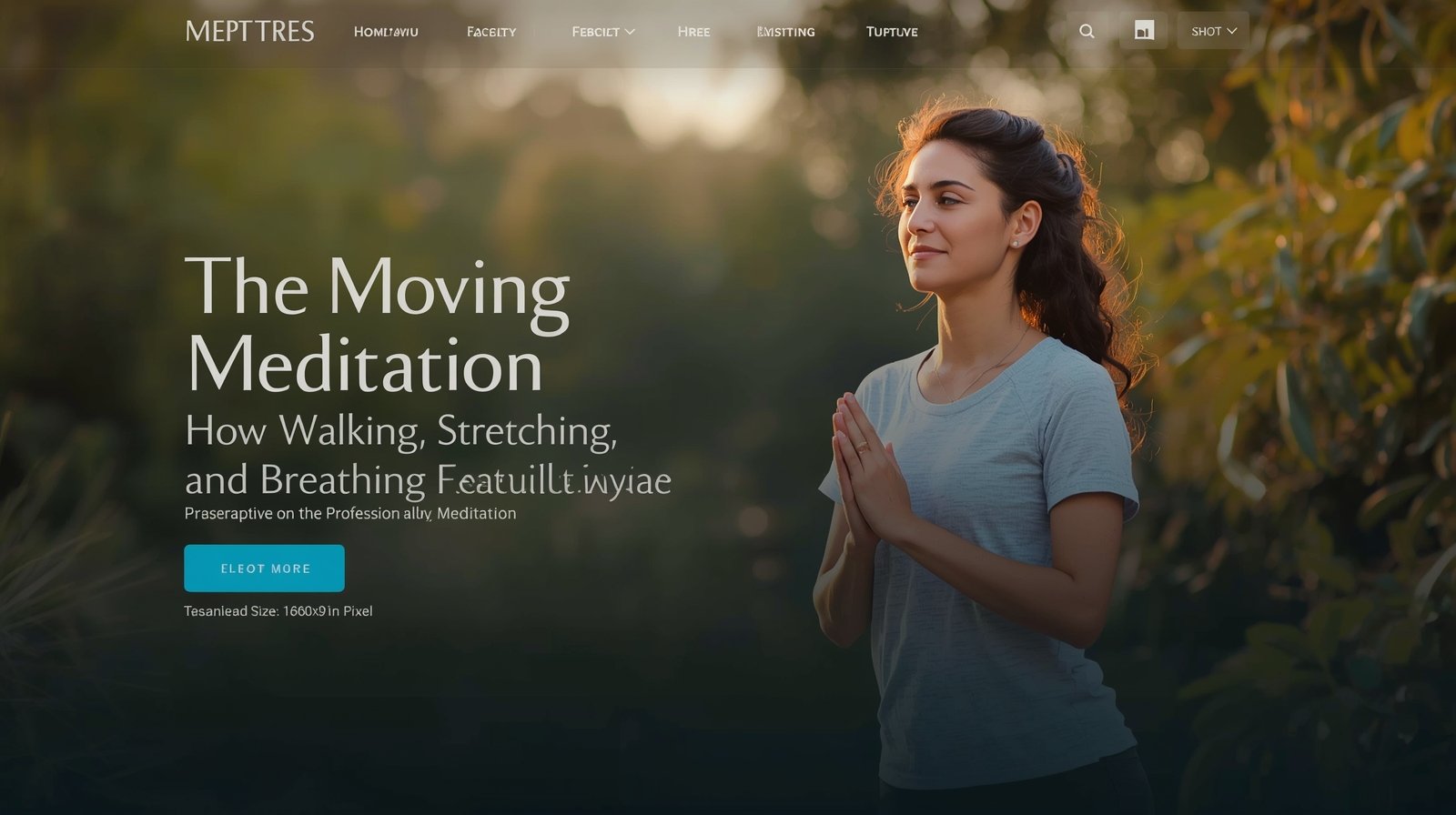

A journey toward stillness through motion — rediscovering presence in a distracted world.
1. The Weight of Constant Attention
Focus — it’s the currency of our time.
Every day, we trade pieces of it for notifications, deadlines, and endless scrolling. We’re told to “stay focused,” but no one teaches us how to reclaim it once it slips away.
We live in an age of divided attention — where stillness feels uncomfortable and productivity has become a form of validation. Many of us move through the day like overworked machines, running on caffeine and obligation, disconnected from our bodies and breath.
But what if focus isn’t something we fight to hold onto?
What if it’s something we can rebuild — gently, rhythmically — through movement itself?
That’s the heart of moving meditation: the practice of finding clarity, calm, and focus not by sitting still, but by being fully present in motion.
2. Rediscovering the Ancient Wisdom of Movement
Long before modern mindfulness apps and ergonomic chairs, humans meditated by walking, working, and breathing with awareness. Ancient monks in Japan practiced kinhin — walking meditation — as a way to integrate mindfulness into daily life. Yogis in India used asana (physical postures) and pranayama (breathing) not to stretch the body, but to prepare the mind for stillness.
Our ancestors understood something we often forget:
Stillness isn’t the absence of movement — it’s the presence of awareness within movement.
When you walk with purpose, when you stretch slowly and breathe consciously, you begin to inhabit your body again. You start to sense the world not through noise, but through rhythm.
That rhythm is where focus lives.
3. The Science of Moving Mindfully
Modern neuroscience now echoes what ancient wisdom has always known — that mindful movement can reset the nervous system and sharpen concentration.
Walking activates both hemispheres of the brain, balancing analytical and creative thinking. It increases blood flow to the prefrontal cortex — the center of decision-making and focus. This is why so many breakthroughs happen during a stroll rather than at a desk.
Stretching signals safety to the body. When muscles release tension, the brain receives a message that it can relax too. This reduces cortisol (the stress hormone), which is one of the biggest enemies of sustained focus.
Breathing — especially slow, deep diaphragmatic breathing — activates the parasympathetic nervous system, shifting us from fight-or-flight to rest-and-restore. Within minutes, heart rate slows, blood pressure drops, and cognitive clarity improves.
In other words, movement doesn’t distract the mind — it detoxes it.
4. The Walk That Changed My Day
A few years ago, I found myself drowning in deadlines. I was working from home, glued to my laptop, trying to power through brain fog with more coffee. The harder I tried to focus, the worse it got — until my thoughts felt like static.
So I did something strange for me at the time: I stepped outside and went for a walk. No podcast, no phone. Just me and the sound of my footsteps on the pavement.
For the first few minutes, my mind rebelled. It wanted stimulation, distraction, input. But gradually, something shifted. I started noticing the rhythm of my breath syncing with my steps. My thoughts began to slow. The world expanded again — the smell of rain, the warmth of sunlight, the chatter of leaves.
By the time I returned home 30 minutes later, I felt clear. Focused. Not from force, but from flow.
That walk taught me something simple yet profound: motion creates mental space. It’s not about escaping work; it’s about returning to it from a calmer, more centered place.
5. The Three Pillars of Moving Meditation
There are many ways to practice, but at its core, moving meditation rests on three pillars: walking, stretching, and breathing.
Let’s explore how each one rebuilds focus in its own way.
A. Walking: The Path to Presence
Walking is our oldest form of meditation — a practice that reconnects body and mind through rhythm. When done intentionally, it transforms from exercise into awareness.
How to practice:
- Step outside or walk indoors without distractions.
- Match your breath to your steps — for example, inhale for 4 steps, exhale for 4.
- Notice sensations: your feet touching the ground, your arms swinging, the air on your face.
- When your mind wanders (and it will), return gently to your steps.
You’ll notice your thoughts soften. You begin to see patterns — how ideas arise, float, and dissolve. In motion, the mind becomes more fluid. Focus emerges naturally, not as effort, but as ease.
B. Stretching: The Release That Creates Space
Stretching isn’t just for athletes — it’s a form of embodied mindfulness. When you stretch slowly and intentionally, you tune into the tension you’ve been carrying unconsciously — the hunched shoulders, the tight jaw, the shallow chest.
These physical tensions often mirror mental ones. By softening the body, we teach the mind to let go too.
A short mindful stretching ritual:
- Stand tall. Inhale deeply, reaching your arms overhead.
- Exhale slowly as you fold forward, letting your head hang.
- Roll up one vertebra at a time, feeling your spine awaken.
- Gently twist, side-bend, or open your chest — anything that feels like release.
While you stretch, breathe into the tight spots. Don’t force — just listen. The body has its own language, and stretching is how it speaks.
C. Breathing: The Bridge Between Mind and Body
Breath is the most powerful — and overlooked — tool for rebuilding focus. It’s our direct line to the nervous system.
Most of us breathe shallowly, especially when stressed. Our bodies interpret that as danger, keeping the mind in alert mode. But when we slow the breath, everything changes.
Try this simple technique (Box Breathing):
- Inhale for 4 counts.
- Hold for 4.
- Exhale for 4.
- Hold again for 4.
Repeat 5–10 rounds. This pattern signals the brain: “You’re safe. You can focus.” Within minutes, your attention stabilizes.
Breath anchors us — it’s the moving meditation that’s always available, anywhere, anytime.
6. Why Stillness Alone Isn’t Enough
Many people struggle with traditional meditation because it feels like fighting the mind. Sitting still when your thoughts are racing can create frustration instead of calm.
But moving meditation works with the mind, not against it.
It channels restless energy into something fluid and constructive.
When you walk, stretch, or breathe consciously, you give your brain a task — a gentle focus point that quiets mental noise without force. You enter a state of active calm — focused but relaxed, alert yet soft.
This is why moving meditation is so powerful for modern life: it honors the truth that we’re not meant to be still all the time. Our bodies are made to move — and through that movement, our minds can find stillness.
7. The Focus Rebuild: What Happens Over Time
When practiced consistently, moving meditation rewires the way you relate to attention itself.
Here’s what changes:
- You recover faster from distraction. Instead of spiraling into frustration, you take a breath and return.
- You think more clearly. Movement increases oxygen and blood flow to the brain, sharpening memory and creativity.
- You handle stress better. The body learns calm as a default setting.
- You become more embodied. You stop living from the neck up — life starts to feel grounded again.
- You rediscover joy in small things. Ordinary moments — walking to work, stretching after a call — become portals to presence.
Over time, focus stops feeling like a discipline and becomes a natural rhythm — something that rises and falls with grace.
8. Blending Movement Into Modern Life
You don’t need to escape to a mountain retreat to practice moving meditation. You can integrate it into the fabric of daily life.
In the morning: Start the day with five minutes of slow breathing and stretching before touching your phone.
At work: Take walking meetings. Stand up every hour. Pause to inhale deeply before replying to emails.
After work: Walk without headphones. Let your senses reset.
Before bed: Gentle yoga or breathing helps release the day from your muscles and mind.
The goal isn’t perfection. It’s awareness. Even two mindful breaths can shift your state.
We often underestimate the small, physical acts that recalibrate the mind. But consistency — not intensity — is what rebuilds focus.
9. The Emotional Layer: Healing Through Motion
Moving meditation doesn’t just restore focus; it heals.
Many emotions live in the body — anxiety in the chest, anger in the jaw, grief in the shoulders. When we move mindfully, we give these emotions room to breathe.
Walking through sadness. Stretching through overwhelm. Breathing through fear.
Each motion becomes a quiet form of release.
Focus isn’t only about concentration; it’s about clarity. And clarity often arrives when we’ve made space for what’s been held too long.
In that sense, movement becomes both meditation and medicine.
10. Reclaiming the Rhythm of Attention
There’s a misconception that focus is a straight line — start, sustain, succeed.
But real focus is cyclical, like breath. It expands and contracts, sharpens and softens.
When you honor that rhythm — when you let movement and stillness complement each other — you stop fighting your mind. You start flowing with it.
We rebuild focus not by tightening control, but by loosening it — just enough for awareness to move naturally again.
11. A Walk, A Stretch, A Breath — A Return
So much of life today pulls us away from ourselves. The phone buzzes, the inbox fills, the mind scatters. But the body — the body always knows the way back.
Every walk is a reminder: I’m here.
Every stretch whispers: I’m alive.
Every breath says: I’m enough.
You don’t need an app or a schedule to meditate.
You only need to move — and notice that you are moving.
In the gentle choreography of walking, stretching, and breathing, focus rebuilds itself — quietly, like morning light returning after a long night.
12. The Stillness in Motion
In the end, moving meditation isn’t about escaping chaos — it’s about learning to stay centered within it.
To find stillness inside motion.
To breathe through the noise, walk through the overwhelm, stretch through the tension, and arrive — fully — in the moment you’re in.
Focus isn’t lost. It’s just buried under hurry.
And sometimes, the only way to find it again
is to start moving — one breath, one step, one stretch at a time.